


How structured delivery architecture drove a 6.6% conversion uplift across millions of listings.
Organisational Influence
Platform Thinking
Systems Design

TL:DR
Over 12 months, I led Shipping Transparency across three cross-functional squads spanning seller tooling and buyer experiences on Web and mobile. The initiative introduced a scalable structured shipping architecture across millions of listings, repositioning delivery information from a hidden detail to a primary decision signal.
This work strengthened buyer trust, improved commercial performance, and established a reusable platform capability.
Scope
Role
Impact
The context
Background
Trade Me has historically been perceived as a second-hand marketplace rather than a credible destination for new goods. As global e-commerce expectations accelerated—particularly during COVID-19—this perception became a commercial risk.
In response, Trade Me invested in a multi-year transformation to become a competitive goods marketplace. I was part of a senior design group that defined a five-year product vision to support this shift, ultimately securing long-term investment under the strategy “Best in range, delivered quick smart.”
The Problem
Trade Me needed to compete with global e-commerce leaders while supporting one of the most complex seller ecosystems in the market.
The marketplace includes:
Buyer research and competitive analysis revealed a critical gap: buyers lacked clear, trustworthy shipping information early in their decision-making process.
This created friction at the exact moment buyers were comparing listings, leading to hesitation, watchlisting instead of purchasing, or abandoning the journey altogether.
Constraints
Vision
Shipping transparency vision poster
My strategic goal was to move shipping from a hidden detail to a primary decision signal—without overwhelming buyers or fragmenting the experience.
The core hypothesis:
We can improve Trade Me for buyers and increase conversion by providing upfront/transparent shipping information (speed, price, availability)
This required:
Crucially, this was not a UI problem alone and required aligning design, product, and engineering around a shared architectural and experiential vision.
Research
User research
At the beginning of the project, we conducted user interviews and surveys to understand buyer pain points around shipping. I facilitated the user research testing concepts through 1 hour long user interviews. From this research we could conclude that our hypothesis “We can improve Trade Me for buyers and increase conversion by providing upfront/transparent shipping information (speed, price, availability)” was worth pursuing and we were solving a real user problem.
"I like that you can see the shipping charges. It's quite annoying to [have to] go through and look at how much it is."
"The inconsistency of delivery info is annoying but not unexpected from Trade Me. It is an expectation from other e-commerce. Trade Me is person to member not a company [so the expectations are not the same]."
User journey
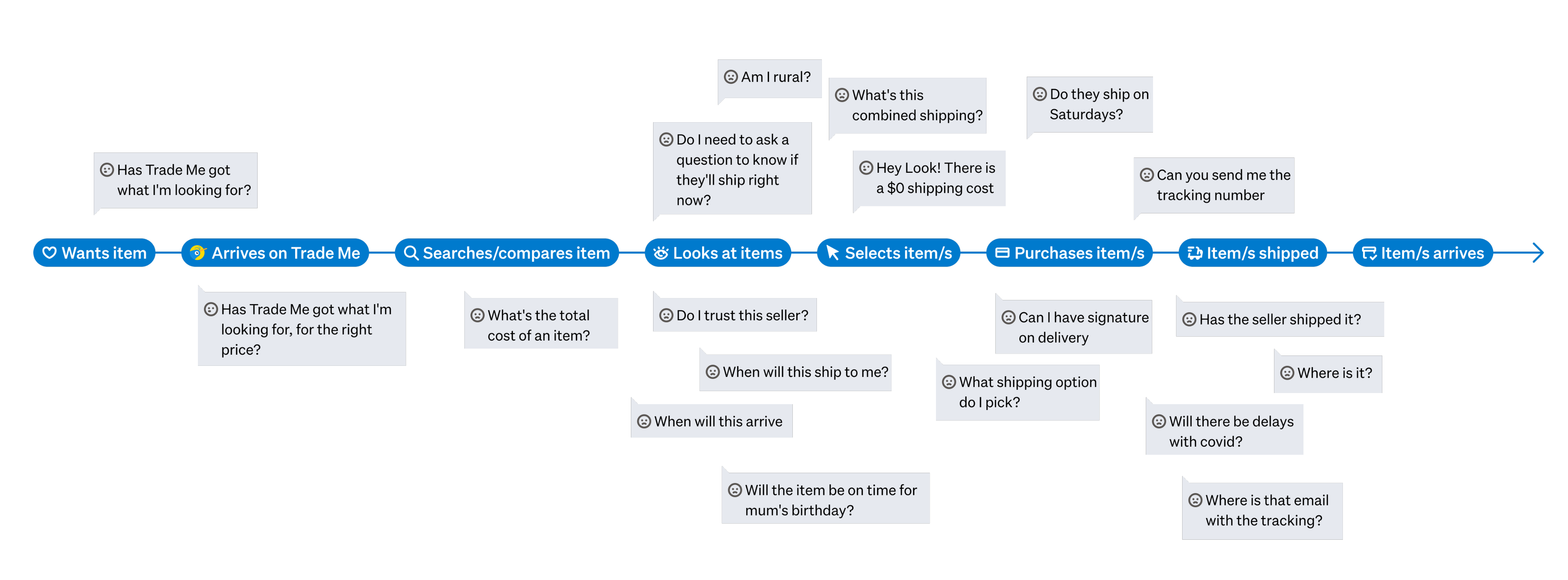
To help communicate the challenges faced by our users to the team I created a user journey outlining user challenges to communicate the problems we were facing and build empathy with the users. The was built from user testing that was conducted that formed the strategy.
Shipping transparency user journey
Execution
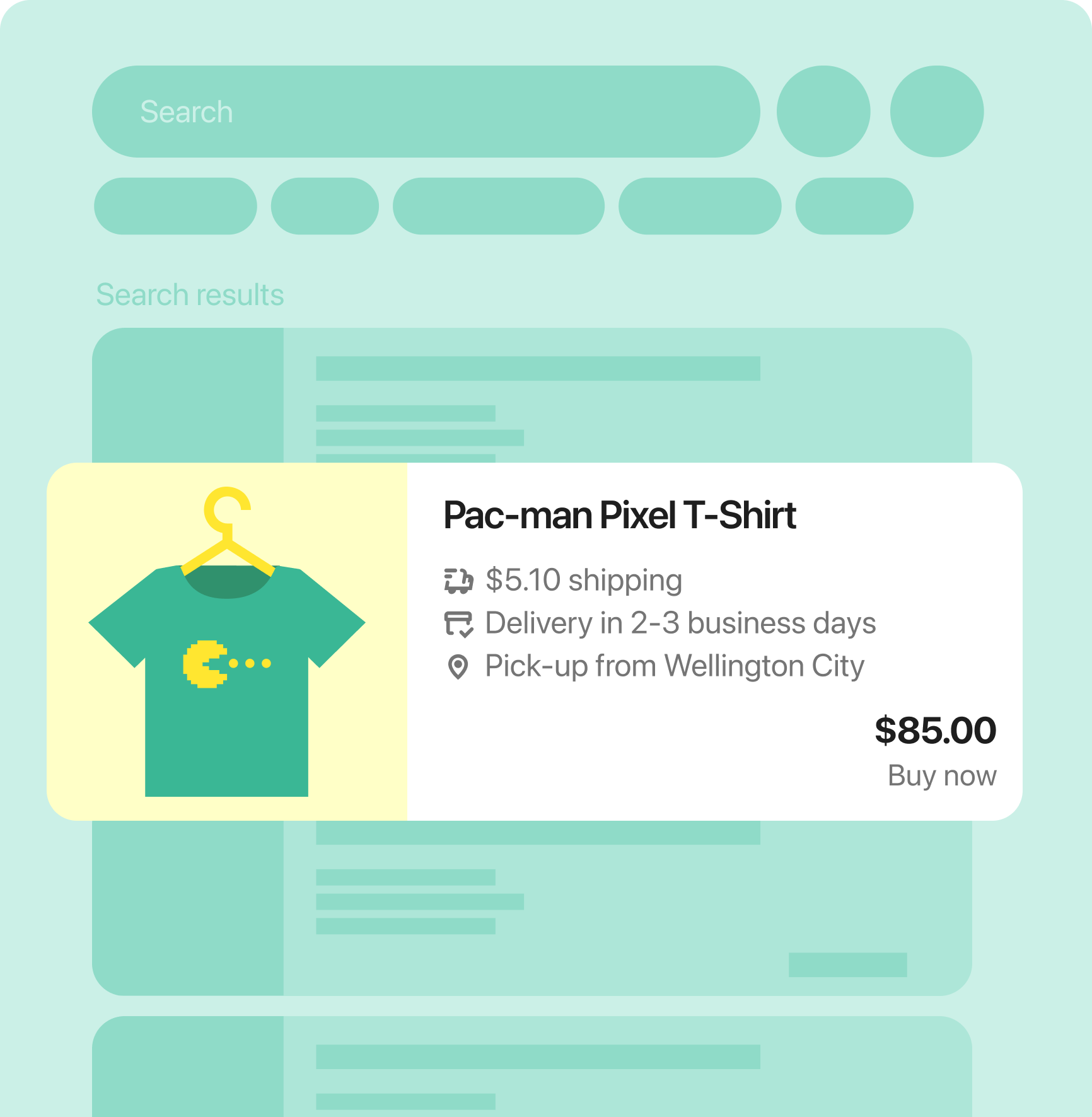
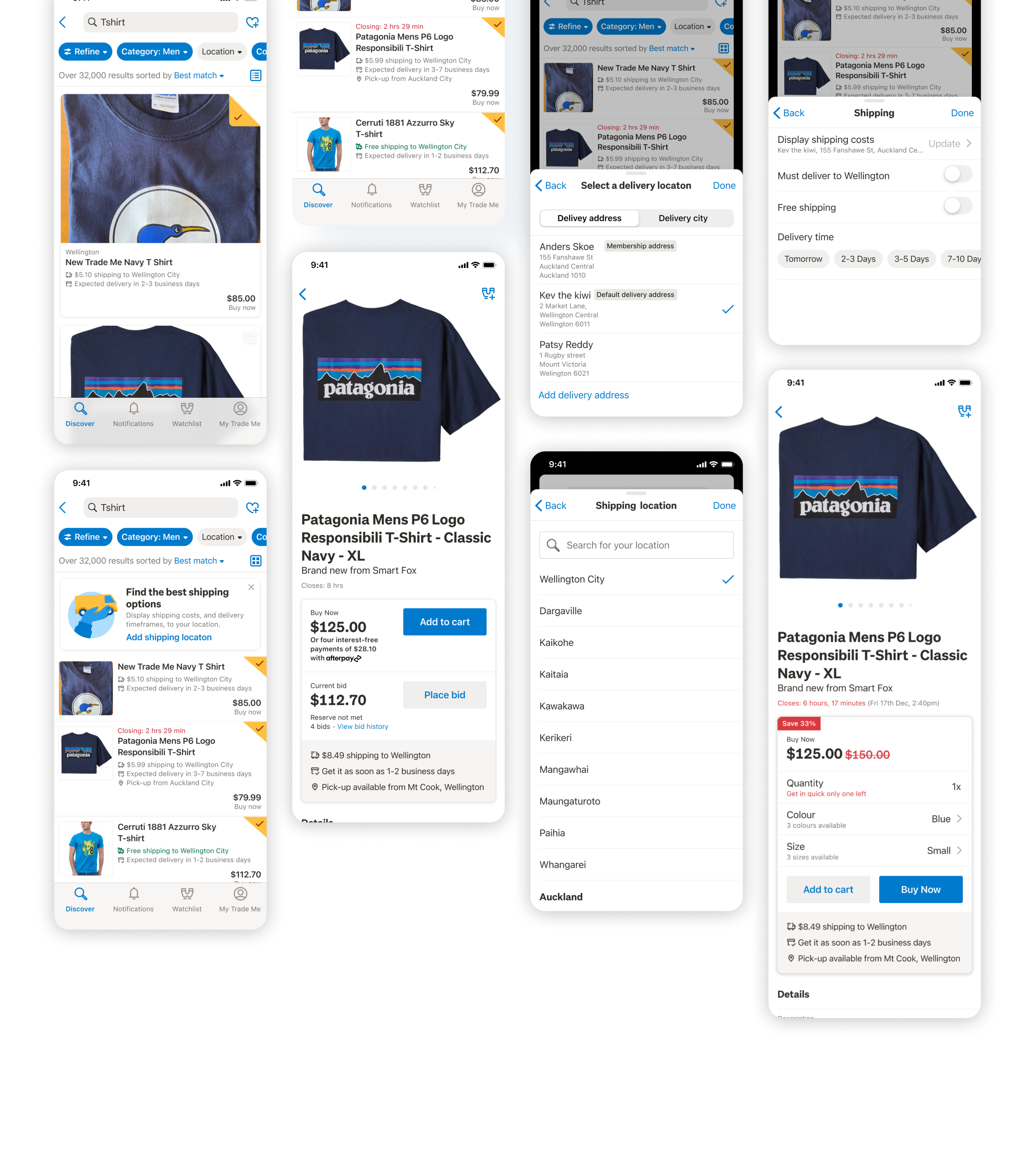
Shipping information displayed in search.
This allows users to quickly scan and understand the full cost in search simplify item comparison

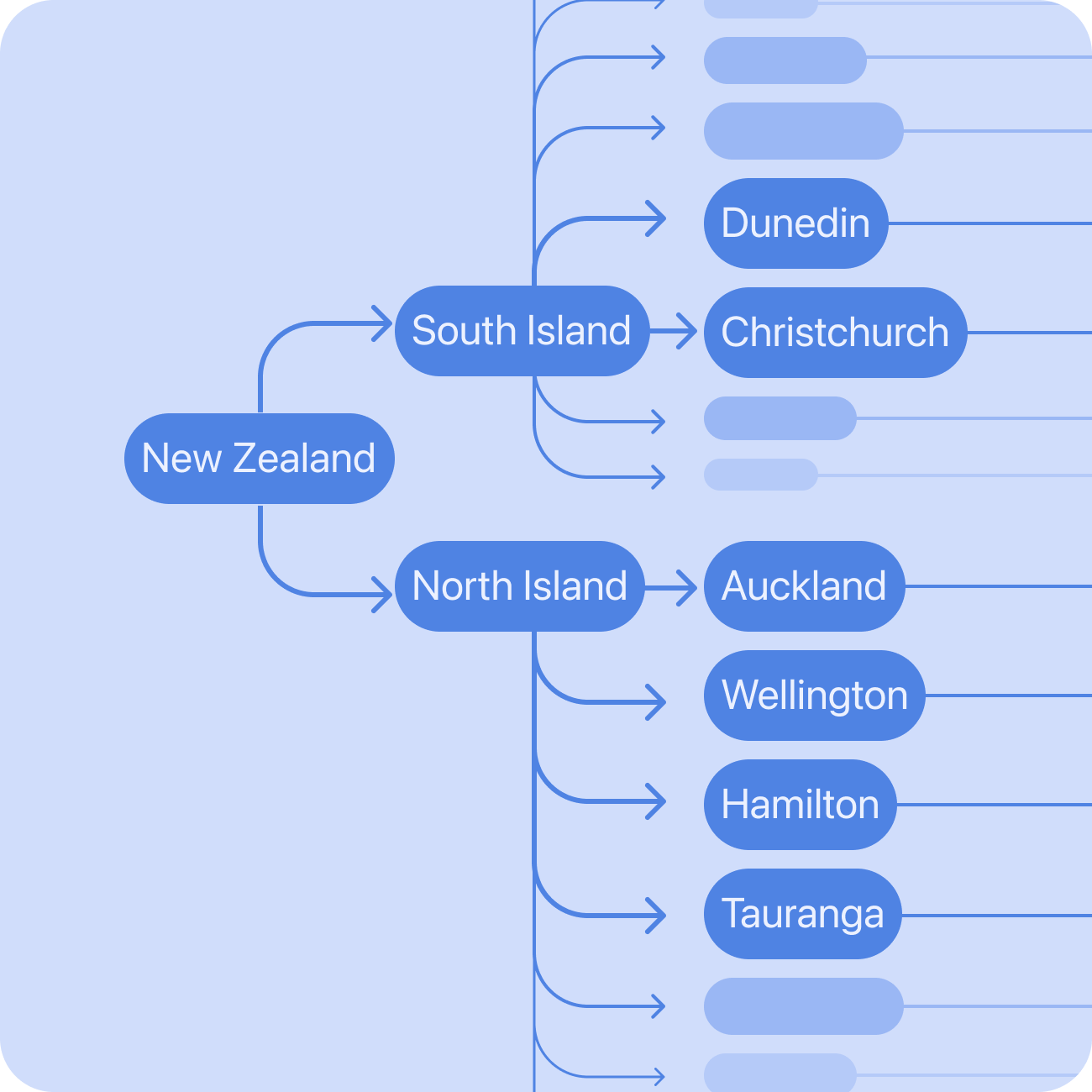
Consistent delivery logic across millions of listings
To achieve a contest delivery logic I worked the the engineering team to shape the technical direction. We agreed to create a shipping tree to make exact shipping costs to buyers delivery addresses

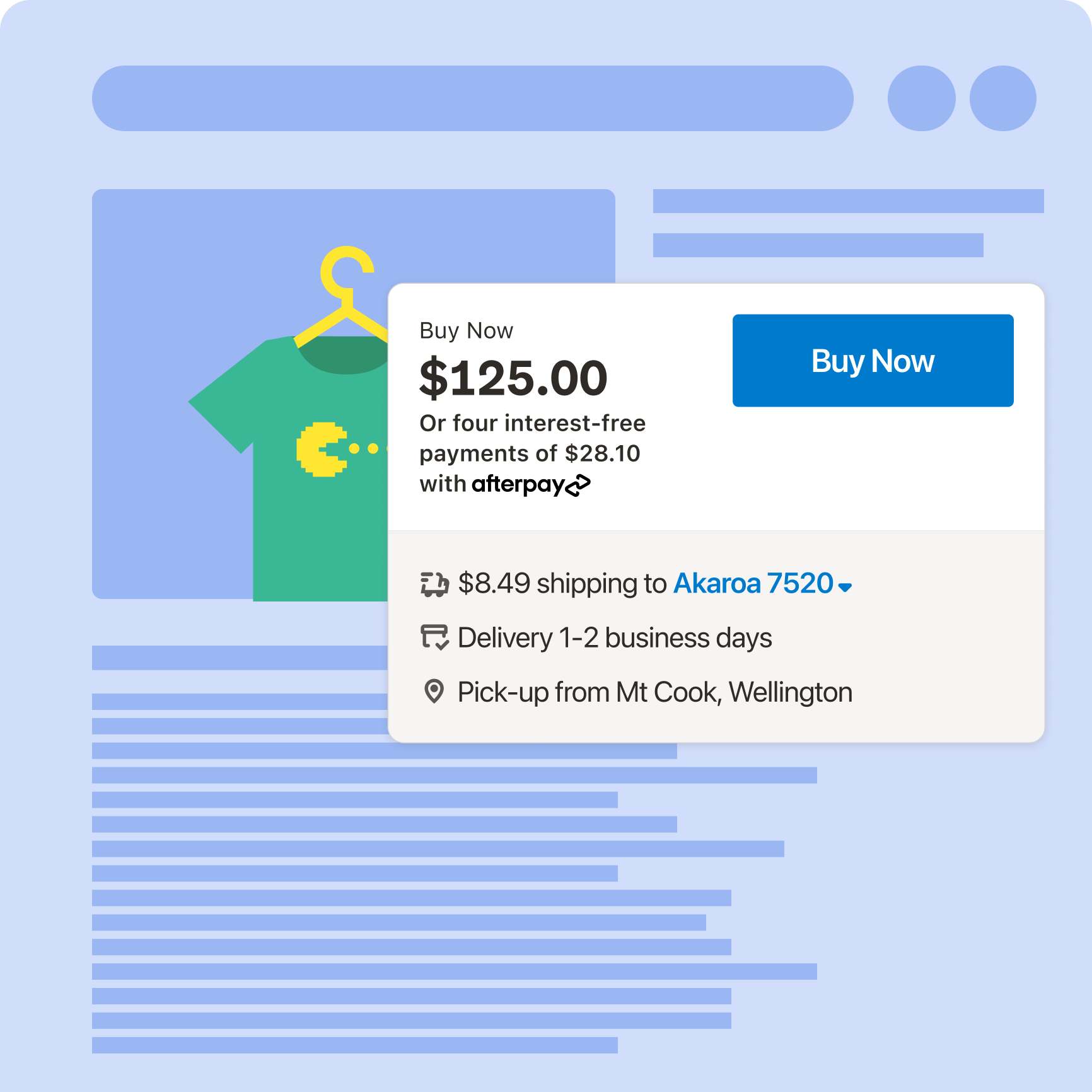
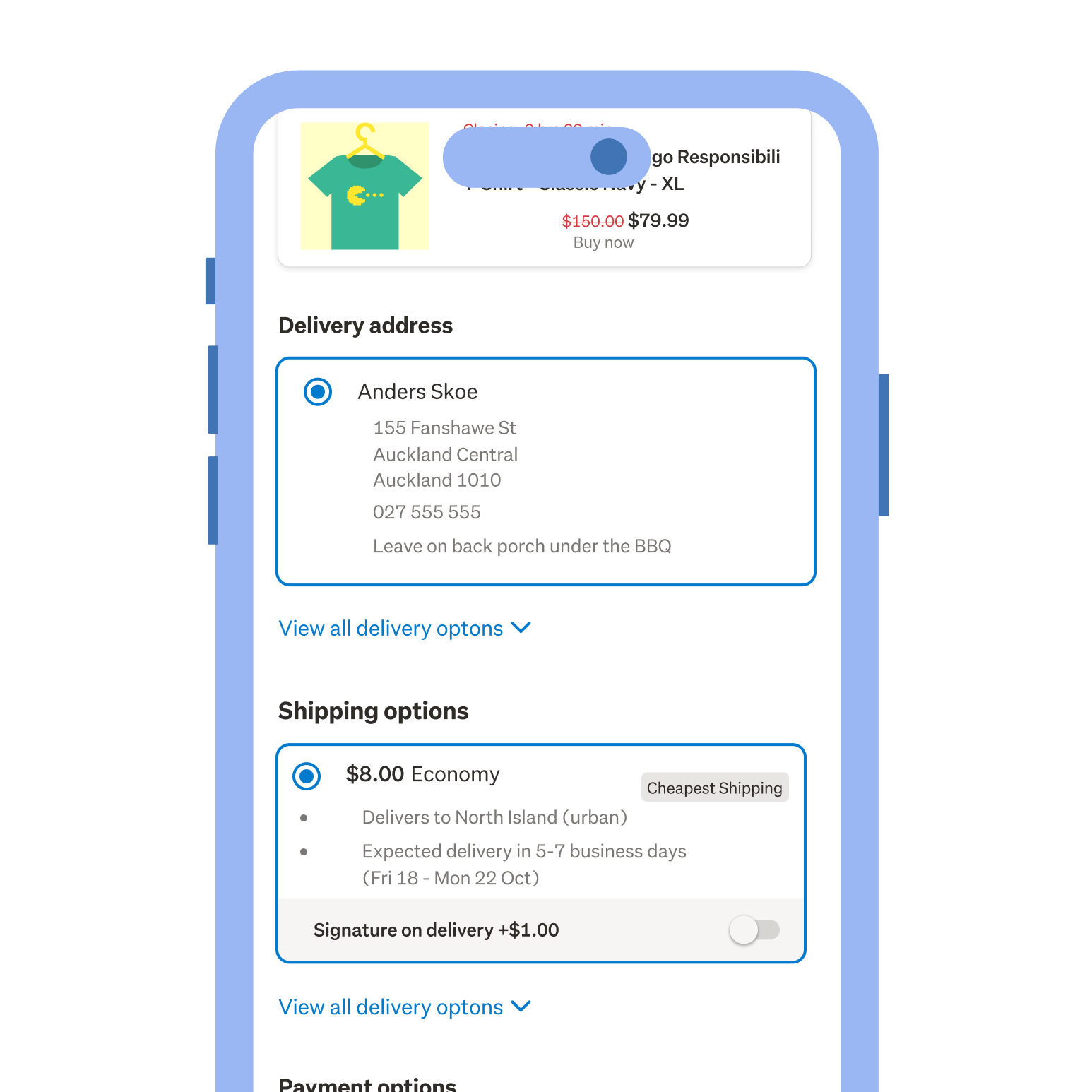
Clear Shipping in the purchase journey
We aimed to make shipping information visible where it mattered most, at the start of the purchase journey.

Simplified purchase
With the new shipping logic we are now able to match the users delivery address to the correct shipping costs removing an unconventional step in the purchase process simplifying the user journey.
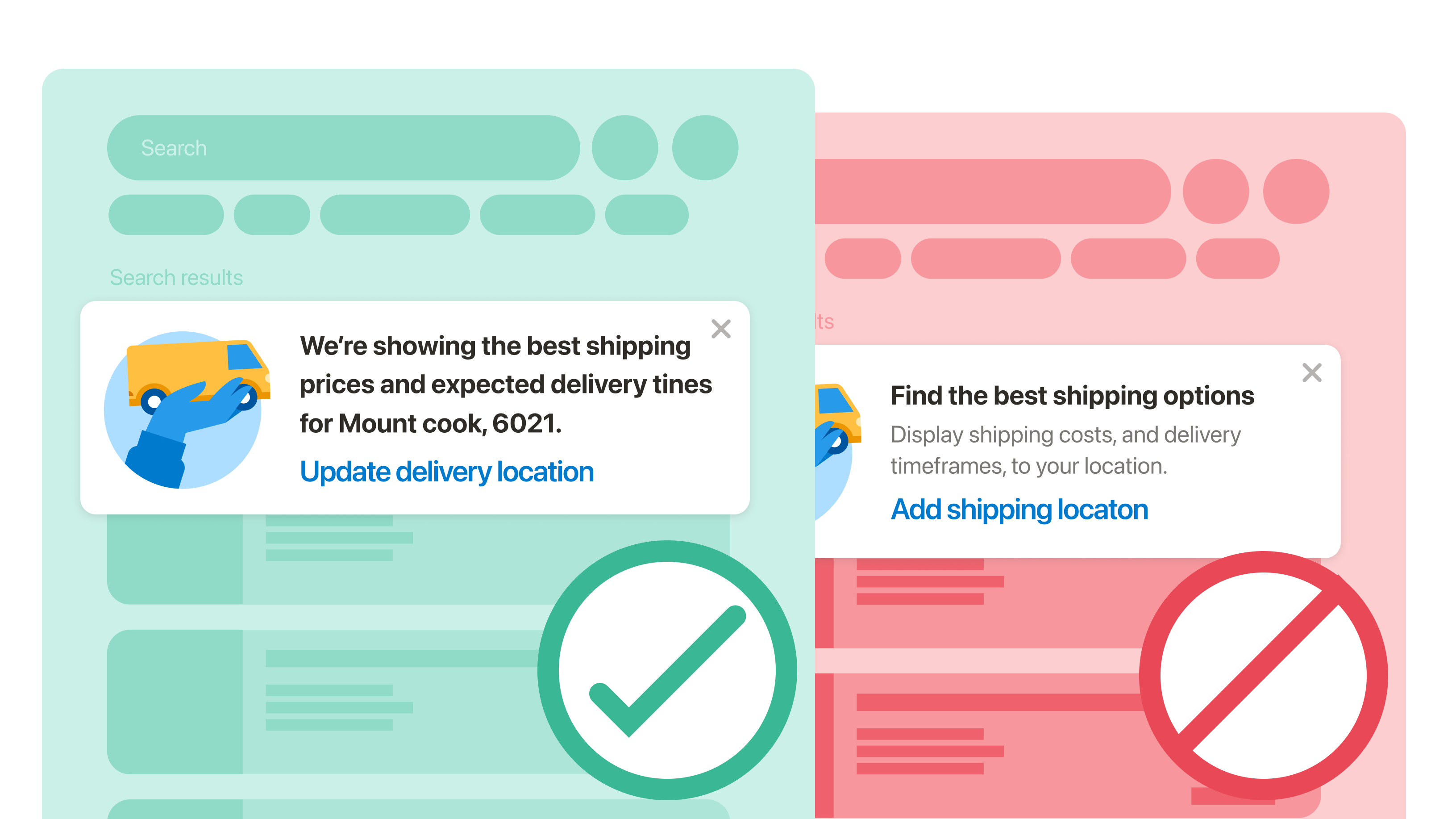
No user action onboarding
We started with an opt-in to deliver value quickly. I hypothesised that an opt-in wasn’t going to achieve the goal to get a majority of buyers with the new delivery information. With a low result in the single digits my hypothesis was proved correct and we automatically matched up the shipping architecture with last used delivery address.

Impact
Commercial impact

+6.6%
relative increase in Listing View to Purchase conversion

+3.9%
relative increase in Listing View to Watchlist conversion
Customer impact

79%
of buyers rated the new shipping information “very” or “extremely helpful”

85%
Pro-seller adoption of the new shipping templates
My Leadership
Aligning Three Squads Around a Shared Outcome
Three squads were working in parallel (Seller, Search, Purchase), with diffuse stakeholder input and unclear decision ownership slowing delivery. Partnering with the PM, I helped introduce:
I stepped into a cross-stream design lead role, aligning three designers and ensuring architectural coherence across surfaces. This prevented fragmented execution and local optimisation.
Extending the Architecture
Trade Me’s legacy architecture and highly fragmented seller ecosystem made consistent shipping information difficult to deliver. Instead of designing an idealised experience disconnected from feasibility, I partnered early with engineering to shape a scalable shipping data model and define guardrails for accuracy and adoption. This allowed us to achieve 85% professional seller adoption while still surfacing meaningful, trustworthy delivery information at search—balancing system constraints with user confidence.
Removing Friction to Unlock Impact
Initial release used opt-in onboarding to deliver quicker. But adoption remained in the single digits.
My hypothesis when having this discussion was additional friction would suppress behavioural change, but delivery wanted to release it anyway.
I ensured that we measure this with an A/B experimentation. I was validated which gave me the clear business case and we moved to automatic address matching based on last-used delivery details.
This:
The decision carried risk (privacy, accuracy, cross-device consistency), but protecting simplicity was essential.
Protecting Accuracy Over Cosmetic Simplicity
There was pressure from stake holders to present a single “all-in” final price, Price including shipping.
However:
A simplified total would have misled buyers.
I successfully advocated for:
Prioritising Search (High Leverage, High Cost)
We made a pivotal decision to prioritise Search over Listing Page. Search is where comparison decisions happen. Moving shipping there required deeper architectural investment but unlocked behavioural impact. To enable this, I partnered closely with Engineering to shape a structured shipping data model (“shipping tree”) capable of:
We deliberately chose structured templates over seller free-text flexibility.
Trade-off
Result
Extended through to motors
The system I created extended through to motors
What This Demonstrates
Lead complex, multi-team initiatives with shared ownership
Leading a group of designers across the seller and buyer journeys balancing the outcomes for both user groups.
Organisational Influence

Navigate technical constraints without compromising user value
Trade Me’s legacy architecture and highly fragmented seller ecosystem made consistent shipping information difficult to deliver. Instead of designing an idealised experience disconnected from feasibility, I partnered early with engineering to shape a scalable shipping data model and define guardrails for accuracy and adoption. This allowed us to achieve 85% professional seller adoption while still surfacing meaningful, trustworthy delivery information at search—balancing system constraints with user confidence.
Systems Design

Use design as a strategic lever for commercial outcomes
Rather than treating shipping visibility as a UI enhancement, I framed it as a conversion and trust lever critical to Trade Me’s competitiveness in e-commerce.
Business Impact

Align long-term platform thinking with near-term delivery
I positioned Shipping Transparency as more than a feature, it was a foundational capability. While we delivered immediate value by surfacing shipping information.
Platform Thinking

The success of Shipping Transparency contributed directly to Trade Me’s evolving brand perception.
Trade Me has historically been perceived as a second-hand marketplace rather than a credible goods destination. By elevating structured shipping information to a first-class decision signal, we aligned the experience more closely with modern e-commerce expectations.
Change Leadership

Operate effectively at Lead level across product, design, and engineering
My role extended beyond design execution. I shaped the strategic framing, influenced prioritisation decisions, guided technical feasibility discussions, and maintained experience quality across multiple teams. By connecting user insight to platform architecture and commercial goals, I operated as a cross-functional leader—ensuring that design, product, and engineering moved in the same direction while maintaining high standards of delivery and measurable impact.
Strategic Leadership

Gallery
iOS
Android
Web
How structured delivery architecture drove a 6.6% conversion uplift across millions of listings.
Organisational Influence
Platform Thinking
Systems Design

TL:DR
Over 12 months, I led Shipping Transparency across three cross-functional squads spanning seller tooling and buyer experiences on Web and mobile. The initiative introduced a scalable structured shipping architecture across millions of listings, repositioning delivery information from a hidden detail to a primary decision signal.
This work strengthened buyer trust, improved commercial performance, and established a reusable platform capability.
Scope
Role
Impact
The context
Background
Trade Me has historically been perceived as a second-hand marketplace rather than a credible destination for new goods. As global e-commerce expectations accelerated—particularly during COVID-19—this perception became a commercial risk.
In response, Trade Me invested in a multi-year transformation to become a competitive goods marketplace. I was part of a senior design group that defined a five-year product vision to support this shift, ultimately securing long-term investment under the strategy “Best in range, delivered quick smart.”
The Problem
Trade Me needed to compete with global e-commerce leaders while supporting one of the most complex seller ecosystems in the market.
The marketplace includes:
Buyer research and competitive analysis revealed a critical gap: buyers lacked clear, trustworthy shipping information early in their decision-making process.
This created friction at the exact moment buyers were comparing listings, leading to hesitation, watchlisting instead of purchasing, or abandoning the journey altogether.
Constraints
Vision
Shipping transparency vision poster
My strategic goal was to move shipping from a hidden detail to a primary decision signal—without overwhelming buyers or fragmenting the experience.
The core hypothesis:
We can improve Trade Me for buyers and increase conversion by providing upfront/transparent shipping information (speed, price, availability)
This required:
Crucially, this was not a UI problem alone and required aligning design, product, and engineering around a shared architectural and experiential vision.
Research
User research
At the beginning of the project, we conducted user interviews and surveys to understand buyer pain points around shipping. I facilitated the user research testing concepts through 1 hour long user interviews. From this research we could conclude that our hypothesis “We can improve Trade Me for buyers and increase conversion by providing upfront/transparent shipping information (speed, price, availability)” was worth pursuing and we were solving a real user problem.
"I like that you can see the shipping charges. It's quite annoying to [have to] go through and look at how much it is."
"The inconsistency of delivery info is annoying but not unexpected from Trade Me. It is an expectation from other e-commerce. Trade Me is person to member not a company [so the expectations are not the same]."
User journey
To help communicate the challenges faced by our users to the team I created a user journey outlining user challenges to communicate the problems we were facing and build empathy with the users. The was built from user testing that was conducted that formed the strategy.
Shipping transparency user journey
Execution
Shipping information displayed in search.
This allows users to quickly scan and understand the full cost in search simplify item comparison

Consistent delivery logic across millions of listings
To achieve a contest delivery logic I worked the the engineering team to shape the technical direction. We agreed to create a shipping tree to make exact shipping costs to buyers delivery addresses

Clear Shipping in the purchase journey
We aimed to make shipping information visible where it mattered most, at the start of the purchase journey.

Simplified purchase
With the new shipping logic we are now able to match the users delivery address to the correct shipping costs removing an unconventional step in the purchase process simplifying the user journey.
No user action onboarding
We started with an opt-in to deliver value quickly. I hypothesised that an opt-in wasn’t going to achieve the goal to get a majority of buyers with the new delivery information. With a low result in the single digits my hypothesis was proved correct and we automatically matched up the shipping architecture with last used delivery address.

Impact
Commercial impact

+6.6%
relative increase in Listing View to Purchase conversion

+3.9%
relative increase in Listing View to Watchlist conversion
Customer impact

79%
of buyers rated the new shipping information “very” or “extremely helpful”

85%
Pro-seller adoption of the new shipping templates
My Leadership
Aligning Three Squads Around a Shared Outcome
Three squads were working in parallel (Seller, Search, Purchase), with diffuse stakeholder input and unclear decision ownership slowing delivery. Partnering with the PM, I helped introduce:
I stepped into a cross-stream design lead role, aligning three designers and ensuring architectural coherence across surfaces. This prevented fragmented execution and local optimisation.
Extending the Architecture
Trade Me’s legacy architecture and highly fragmented seller ecosystem made consistent shipping information difficult to deliver. Instead of designing an idealised experience disconnected from feasibility, I partnered early with engineering to shape a scalable shipping data model and define guardrails for accuracy and adoption. This allowed us to achieve 85% professional seller adoption while still surfacing meaningful, trustworthy delivery information at search—balancing system constraints with user confidence.
Removing Friction to Unlock Impact
Initial release used opt-in onboarding to deliver quicker. But adoption remained in the single digits.
My hypothesis when having this discussion was additional friction would suppress behavioural change, but delivery wanted to release it anyway.
I ensured that we measure this with an A/B experimentation. I was validated which gave me the clear business case and we moved to automatic address matching based on last-used delivery details.
This:
The decision carried risk (privacy, accuracy, cross-device consistency), but protecting simplicity was essential.
Protecting Accuracy Over Cosmetic Simplicity
There was pressure from stake holders to present a single “all-in” final price, Price including shipping.
However:
A simplified total would have misled buyers.
I successfully advocated for:
Prioritising Search (High Leverage, High Cost)
We made a pivotal decision to prioritise Search over Listing Page. Search is where comparison decisions happen. Moving shipping there required deeper architectural investment but unlocked behavioural impact. To enable this, I partnered closely with Engineering to shape a structured shipping data model (“shipping tree”) capable of:
We deliberately chose structured templates over seller free-text flexibility.
Trade-off
Result
Extended through to motors
The system I created extended through to motors
What This Demonstrates
Lead complex, multi-team initiatives with shared ownership
Leading a group of designers across the seller and buyer journeys balancing the outcomes for both user groups.
Organisational Influence

Navigate technical constraints without compromising user value
Trade Me’s legacy architecture and highly fragmented seller ecosystem made consistent shipping information difficult to deliver. Instead of designing an idealised experience disconnected from feasibility, I partnered early with engineering to shape a scalable shipping data model and define guardrails for accuracy and adoption. This allowed us to achieve 85% professional seller adoption while still surfacing meaningful, trustworthy delivery information at search—balancing system constraints with user confidence.
Systems Design

Use design as a strategic lever for commercial outcomes
Rather than treating shipping visibility as a UI enhancement, I framed it as a conversion and trust lever critical to Trade Me’s competitiveness in e-commerce.
Business Impact

Align long-term platform thinking with near-term delivery
I positioned Shipping Transparency as more than a feature, it was a foundational capability. While we delivered immediate value by surfacing shipping information.
Platform Thinking

The success of Shipping Transparency contributed directly to Trade Me’s evolving brand perception.
Trade Me has historically been perceived as a second-hand marketplace rather than a credible goods destination. By elevating structured shipping information to a first-class decision signal, we aligned the experience more closely with modern e-commerce expectations.
Change Leadership

Operate effectively at Lead level across product, design, and engineering
My role extended beyond design execution. I shaped the strategic framing, influenced prioritisation decisions, guided technical feasibility discussions, and maintained experience quality across multiple teams. By connecting user insight to platform architecture and commercial goals, I operated as a cross-functional leader—ensuring that design, product, and engineering moved in the same direction while maintaining high standards of delivery and measurable impact.
Strategic Leadership

Gallery
iOS
Android
Web