SEARCH & REFINE

Unifying 2.3M Daily Searches into a Scalable Platform Capability

Strategic Leadership

Platform Thinking

Systems Design

Business Impact

TL:DR

Trade Me was migrating millions of users from its legacy “Classic” platform to a modern responsive architecture. While most areas aimed to preserve familiarity, search (powering ~2.3 million daily queries) had become fragmented after 20 years of independent evolution across Marketplace, Property, Motors, and Jobs.


Each business unit initially planned to redesign search independently. I intervened and reframed search as a shared platform capability rather than four local features, redirecting the rebuild toward a unified system.


As the sole design IC operating at platform level, I defined the refinement model, interaction architecture, and UI framework adopted across web and mobile.

Results

  • Web migration completed with no degradation in search or conversion metrics, protecting core revenue.
  • Mobile rollout delivered a statistically significant +3% CTR uplift.
  • Property added 10 new refinements over 4 years with zero front-end build required.
  • Core components (chips, sliders) were embedded into the design system and reused across the app ecosystem.

The context

Landscape

Search sat inside four business units, each with its own product leadership and local optimisation priorities. There was no existing platform governance model for shared capabilities like search. I operated purely through influence, not mandate.

  • Four business units operating semi-independently
  • Legacy platform (“Classic”) without reusable component architecture
  • Executive pressure to migrate traffic quickly
  • No centralised search governance model
  • No formal authority held by design at platform level

The Problem

Search is was the primary discovery engine driving listing visibility, engagement, and downstream revenue. Any degradation during migration would have had immediate commercial impact. Success was defined not by novelty, but by protecting performance while building for scale. The problem was that trade me classic as a platform was no longer scaleable. It was built on 1990s and early 2000s technology but more importantly the UX was just as dated. there was the risk of UX fragmentation through an independent BU redesign

Constraints

This was not a greenfield rebuild. The work needed to modernise the experience while respecting technical, funding, and timeline limitations.

  • Minimal API changes permitted
  • Tight migration timelines
  • Mobile rebuild funded primarily by Marketplace
  • Vertical-specific bespoke requirements

The process

1

Framing the Strategic Intent

Search was the commercial backbone of Trade Me, powering ~2.3 million daily queries and directly influencing listing visibility, engagement, and revenue flow. After two decades of incremental change, it had become structurally fragmented across business units. The responsive rebuild created a strategic fork in the road: either allow further divergence or unify search as a scalable platform capability.

After 20 years of iteration:

  • Each business unit had evolved its own refinement patterns
  • UI logic diverged across verticals
  • Classic had no reusable component architecture
  • Refinements were inconsistently implemented at the front end
  • Technical and design debt was compounding

The default rebuild plan was to redesign search independently within each business unit. This would likely have resulted in:

  • Four divergent search systems
  • Duplicated engineering effort
  • Slower migration under executive time pressure
  • Long-term platform fragmentation
  • Higher maintenance cost
  • Increased cognitive switching for users moving between verticals

With search driving ~2.3 million searches per day, any degradation during migration risked:

  • Reduced listing views
  • Lower engagement
  • Revenue impact through reduced transaction flow

I reframed search not as a business-unit feature, but as the connective tissue of the platform, a shared capability that required architectural integrity rather than local optimisation.

2

Understanding User and System Complexity

Search needed to support radically different user mindsets:

  • Impulse‑driven marketplace shopping
  • Considered vehicle comparison
  • High‑stakes property and job decisions

At the same time, the underlying system had accrued hundreds of refinements across thousands of categories over two decades.

Rather than treating this as irreducible complexity, I focused on pattern discovery. Through auditing existing refinements across all businesses, I identified:

  • Seven core refinement types, plus a small number of truly bespoke cases

This insight was foundational. It allowed the problem to be simplified into a system that could be designed, built, and communicated clearly across teams.

3

Exploring and Validating Concepts

With a reduced pattern set, I explored multiple conceptual models for how refinements could be surfaced and interacted with across contexts.

To pressure‑test these ideas:

  • Conducted competitor analysis across e‑commerce, motors, property, and jobs platforms
  • Created several end‑to‑end search concepts
  • Ran hour‑long, in‑person usability interviews to test mental models and decision‑making behaviour

A critical finding—reinforced by behavioural data—was the enduring importance of Category and Location, dating back to Trade Me’s original 1999 implementation. Regardless of vertical, users expected these to be immediately accessible.

This led to a key principle: surface the most relevant refinements by context, rather than exposing everything equally.

4

Making the System Explicit

One of the biggest risks in a cross‑business initiative was misalignment: different teams interpreting the solution differently over time.

To address this, I created a UX framework that made the system explicit. It defined:

  • Refinement types and their behaviours
  • Presentation rules across devices
  • Interaction patterns, edge cases, and fallback states

This framework became the shared language between design, product, and engineering. It allowed teams to debate decisions constructively and ensured consistency as the system evolved.

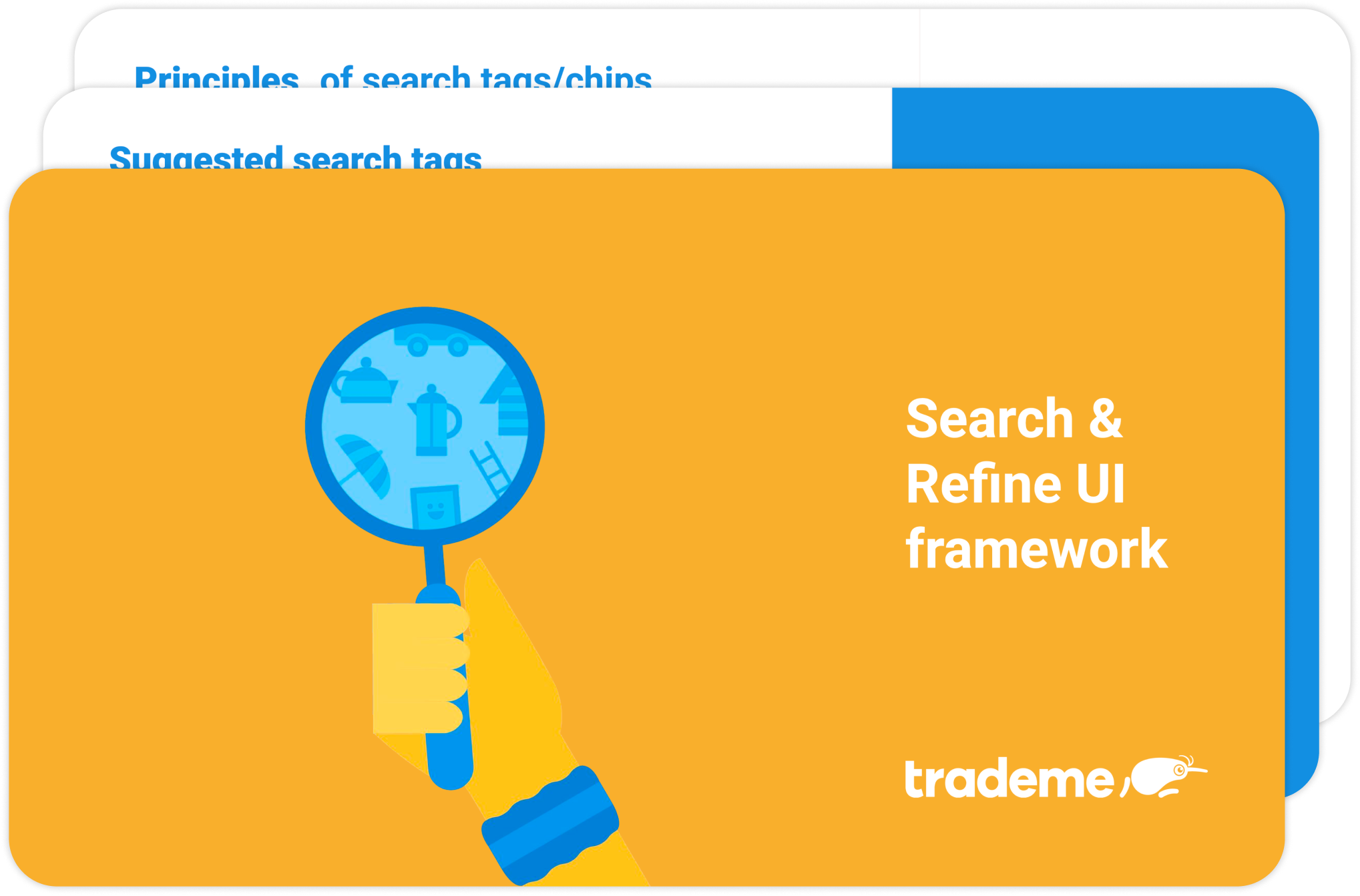
Search & refine UX framework

I created this framework that allowed thousands of categories adapt and series of basic rules to UX predictably and ease of delivery.

View framework

5

Designing for Scale and Longevity

In parallel with the UX framework, I worked closely with engineering to align the design with a scalable technical model:

  • Business logic handled by the API
  • Presentation rules embedded in the front end
  • New refinements could be added without additional front‑end design or build work

This shifted search from a brittle UI implementation to a durable platform capability that could grow with the business.

6

Reducing Risk Through Delivery Strategy

Given the commercial importance of search, success on web was defined primarily by risk reduction, not immediate uplift.

The responsive web rollout focused on:

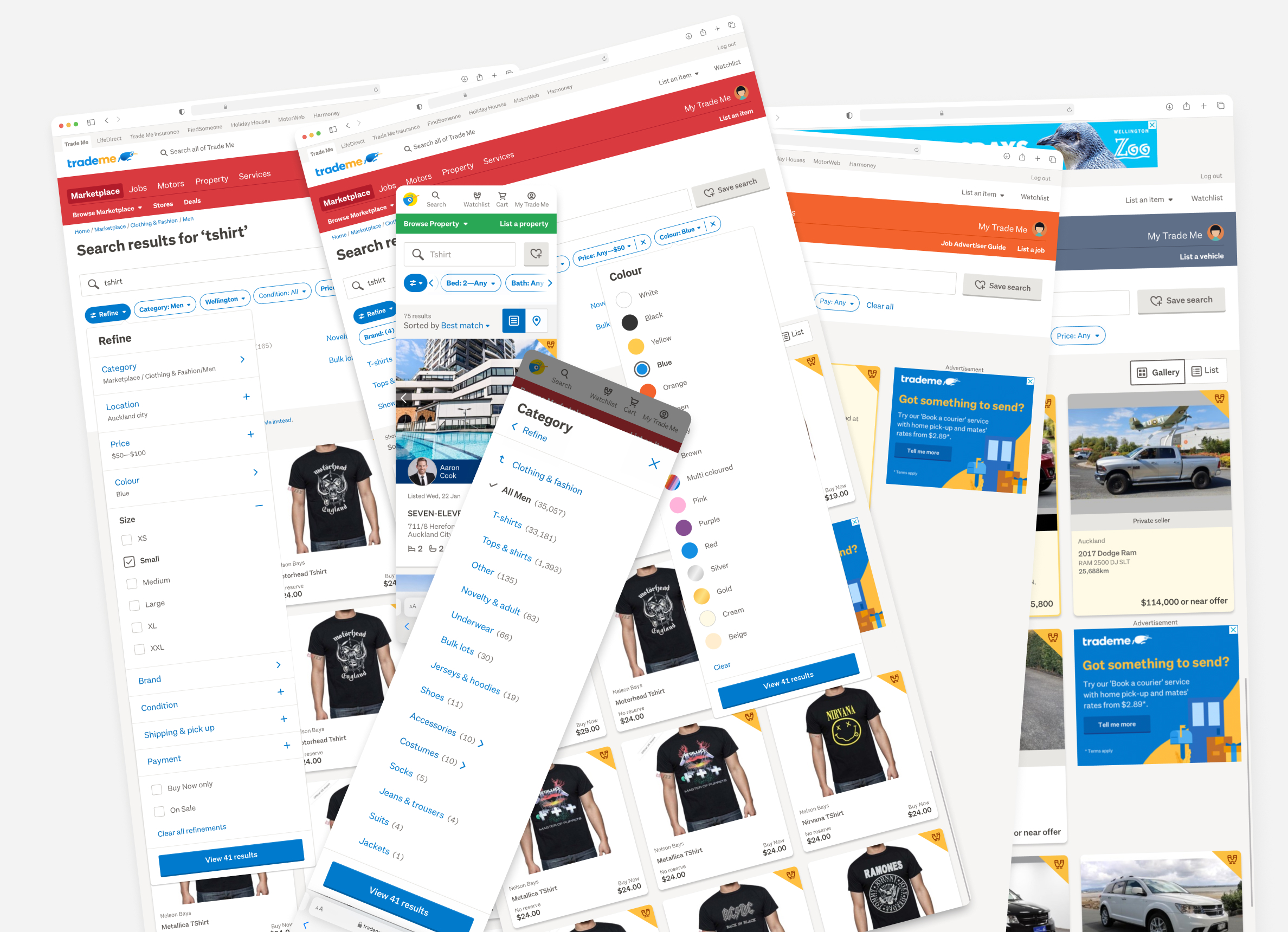
  • Preserving core behaviours during migration from Classic
  • Avoiding drops in members searching or conversion

This strategy was successful: key metrics held steady throughout the transition, validating the system without exposing the business to unnecessary risk.

7

Extending the System to Mobile Apps

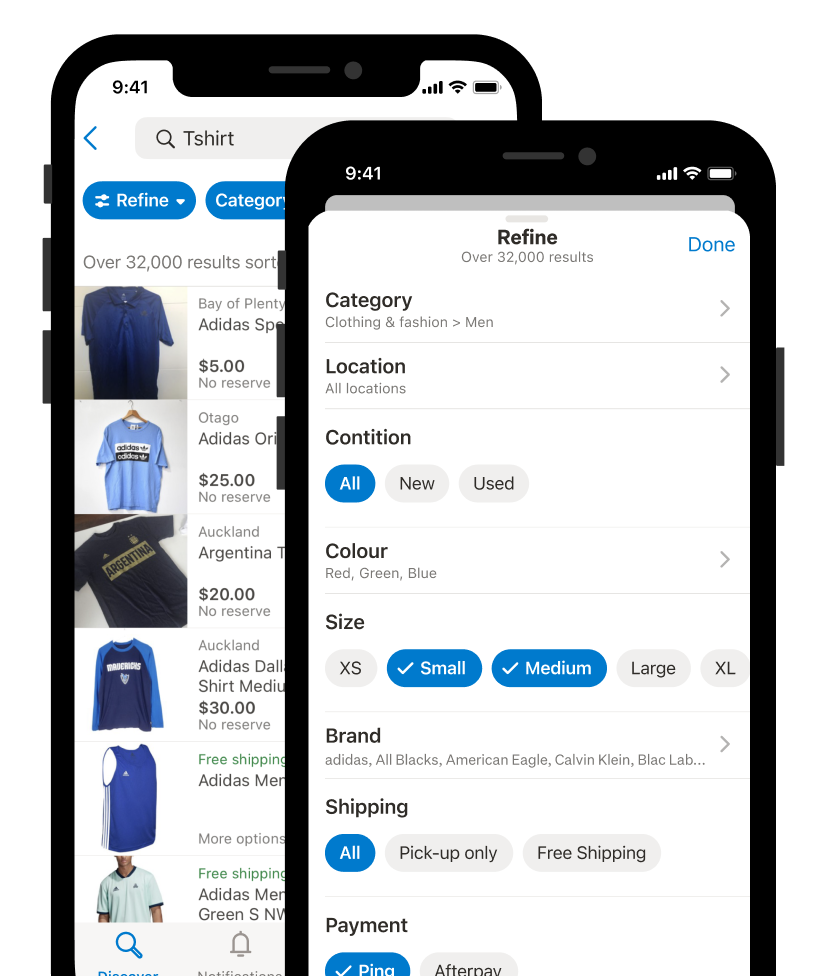
Following the success of the web implementation, I advocated to extend the framework into Trade Me’s mobile apps—the most significant change to mobile search in over a decade.

Rather than porting web patterns directly, we took a native‑first approach, fully leveraging touch interactions:

  • New refinement chip behaviours
  • Horizontal scrolling patterns
  • Bottom sheets for progressive disclosure

To further reduce risk, the rollout was staged over eight months, allowing gradual user adaptation and continuous learning. This Delivered +3% statistically significant CTR uplift

Trade off and tension

This was not a greenfield rebuild.

The ambition to create a unified platform capability had to operate within technical, organisational, and delivery constraints. The goal was not perfection — it was coherence, scalability, and commercial protection within real-world limitations.

Compromises included:

  • Minimal API restructuring
  • Maintaining certain bespoke category behaviours where commercially necessary
  • Deferring deeper backend refactoring to separate discovery work
  • Limiting some multi-select category ambitions due to technical constraints
  • Prioritising cross-platform consistency over vertical-specific optimisation in select cases

For example, I declined a business unit request to introduce a universal title pattern that worked poorly for Property (only ~15% of property users relied on keyword search). I reinforced that shared experience consistency across 2.3 million daily searches outweighed a single-BU preference.

My Leadership

Strategic Reframing

Rather than allow four parallel redesigns, I repositioned search as a shared platform capability. This shifted the conversation from feature redesign to architectural integrity.

  • Identified long-term duplication risk
  • Presented unified cross-BU model
  • Proposed reduction to core interaction patterns
  • Advocated build-once, scale-everywhere approach
  • Influenced stakeholders to pivot direction

Platform & Experience Architecture

The core breakthrough was simplifying thousands of refinements into a small, scalable interaction system that could adapt across verticals and devices.

  • Audited thousands of refinements
  • Identified 7 core refinement types
  • Defined behavioural rules and edge cases
  • Standardised interaction patterns across breakpoints
  • Created formal UI framework documentation
  • Established shared language between design and engineering

Engineering Leverage

The abstraction model was designed not just for usability, but for long-term reduction of duplication and front-end rework.

  • Transitioned from non-component legacy UI to reusable patterns
  • Embedded presentation logic in front-end once
  • API-driven refinement rendering
  • 10+ new Property refinements added with zero new front end build over the last 4+ years
  • Reduced future duplication risk

Organisational Capability Impact

Beyond improving a critical commercial surface, this work strengthened Trade Me’s long-term design and delivery capability by formalising search as a reusable system rather than a feature. It created shared infrastructure, language, and components that continue to scale across the organisation.

  • Created a documented UI framework adopted across teams
  • Established a shared vocabulary between design and engineering
  • Reduced long-term duplication risk across business units
  • Introduced reusable components into the design system:
    • Chips / pills
    • Sliders
    • Bottom sheets
  • Components were adopted beyond search, including:
    • Sell flow
    • Sign-up experiences

This extended the impact beyond a single feature surface and embedded platform thinking into the broader product ecosystem.

Impact

Commercial impact

~2.3 million daily searches migrated without metric degradation

No drop in member search activity

Mobile delivered +3% statistically significant CTR uplift

No drop in conversion during migration

Slider experiments showed up to 40% uplift in price refinement usage

Product & Platform Impact

Unified refinement model across 4 business units

7 core patterns supporting thousands of refinements

Reusable architecture embedded in front-end which enabled 10+ new refinements added without a front end rebuild

Search recognised internally as cross-vertical “glue”

Organisational Capability Impact

Created a documented UI framework adopted across teams

Reduced future duplication risk

What This Demonstrates

Strategic Reframing

Redirected a fragmented multi-BU redesign into a unified platform capability without formal authority.

Strategic Leadership

Commercial Risk Management

Protected core performance metrics during high-risk migration of 2.3M daily searches.

Business Impact

Design System Contribution

Defined reusable components adopted across the broader app ecosystem.

Organisational Influence

Systems Abstraction

Reduced thousands of refinements into 7 scalable interaction models.

Systems Design

Platform Thinking

Cross-Platform Architecture

Aligned web and native interaction logic while respecting device-specific patterns.

Platform Thinking

Reflection

If I repeated this today

With hindsight, there are structural improvements I would drive earlier to increase long-term leverage and measurement rigour. While the system proved durable, I see opportunities to strengthen platform alignment and commercial attribution.

If repeated today, I would:

  • Push earlier for deeper backend/API alignment to further reduce legacy constraints
  • Formalise governance mechanisms to prevent long-term system drift
  • Tie CTR uplift more directly to downstream revenue and commercial metrics

However, within the constraints of timeline, technical limitations, and organisational structure, the work achieved its primary strategic objectives:

  • Protected performance during migration of ~2.3 million daily searches
  • Reduced long-term duplication risk across business units
  • Created a scalable, reusable platform foundation

This project directly contributed to my promotion to Lead Product Designer and marked my transition from senior individual contributor to cross-business platform leader.

Gallery

iOS

Android

Desktop

Mobile

SEARCH & REFINE

How I unified 2.3 million daily searches into a scalable platform without breaking revenue.

Strategic Leadership

Platform Thinking

Systems Design

Business Impact

TL:DR

Trade Me was migrating millions of users from its legacy “Classic” platform to a modern responsive architecture. While most areas aimed to preserve familiarity, search (powering ~2.3 million daily queries) had become fragmented after 20 years of independent evolution across Marketplace, Property, Motors, and Jobs.


Each business unit initially planned to redesign search independently. I intervened and reframed search as a shared platform capability rather than four local features, redirecting the rebuild toward a unified system.


As the sole design IC operating at platform level, I defined the refinement model, interaction architecture, and UI framework adopted across web and mobile.

Results

  • Web migration completed with no degradation in search or conversion metrics, protecting core revenue.
  • Mobile rollout delivered a statistically significant +3% CTR uplift.
  • Property added 10 new refinements over 4 years with zero front-end build required.
  • Core components (chips, sliders) were embedded into the design system and reused across the app ecosystem.

The context

Landscape

Search sat inside four business units, each with its own product leadership and local optimisation priorities. There was no existing platform governance model for shared capabilities like search. I operated purely through influence, not mandate.

  • Four business units operating semi-independently
  • Legacy platform (“Classic”) without reusable component architecture
  • Executive pressure to migrate traffic quickly
  • No centralised search governance model
  • No formal authority held by design at platform level

The Problem

Search is was the primary discovery engine driving listing visibility, engagement, and downstream revenue. Any degradation during migration would have had immediate commercial impact. Success was defined not by novelty, but by protecting performance while building for scale. The problem was that trade me classic as a platform was no longer scaleable. It was built on 1990s and early 2000s technology but more importantly the UX was just as dated. there was the risk of UX fragmentation through an independent BU redesign

Constraints

This was not a greenfield rebuild. The work needed to modernise the experience while respecting technical, funding, and timeline limitations.

  • Minimal API changes permitted
  • Tight migration timelines
  • Mobile rebuild funded primarily by Marketplace
  • Vertical-specific bespoke requirements

The process

1

Framing the Strategic Intent

Search was the commercial backbone of Trade Me, powering ~2.3 million daily queries and directly influencing listing visibility, engagement, and revenue flow. After two decades of incremental change, it had become structurally fragmented across business units. The responsive rebuild created a strategic fork in the road: either allow further divergence or unify search as a scalable platform capability.

After 20 years of iteration:

  • Each business unit had evolved its own refinement patterns
  • UI logic diverged across verticals
  • Classic had no reusable component architecture
  • Refinements were inconsistently implemented at the front end
  • Technical and design debt was compounding

The default rebuild plan was to redesign search independently within each business unit. This would likely have resulted in:

  • Four divergent search systems
  • Duplicated engineering effort
  • Slower migration under executive time pressure
  • Long-term platform fragmentation
  • Higher maintenance cost
  • Increased cognitive switching for users moving between verticals

With search driving ~2.3 million searches per day, any degradation during migration risked:

  • Reduced listing views
  • Lower engagement
  • Revenue impact through reduced transaction flow

I reframed search not as a business-unit feature, but as the connective tissue of the platform, a shared capability that required architectural integrity rather than local optimisation.

2

Understanding User and System Complexity

Search needed to support radically different user mindsets:

  • Impulse‑driven marketplace shopping
  • Considered vehicle comparison
  • High‑stakes property and job decisions

At the same time, the underlying system had accrued hundreds of refinements across thousands of categories over two decades.

Rather than treating this as irreducible complexity, I focused on pattern discovery. Through auditing existing refinements across all businesses, I identified:

  • Seven core refinement types, plus a small number of truly bespoke cases

This insight was foundational. It allowed the problem to be simplified into a system that could be designed, built, and communicated clearly across teams.

3

Exploring and Validating Concepts

With a reduced pattern set, I explored multiple conceptual models for how refinements could be surfaced and interacted with across contexts.

To pressure‑test these ideas:

  • Conducted competitor analysis across e‑commerce, motors, property, and jobs platforms
  • Created several end‑to‑end search concepts
  • Ran hour‑long, in‑person usability interviews to test mental models and decision‑making behaviour

A critical finding—reinforced by behavioural data—was the enduring importance of Category and Location, dating back to Trade Me’s original 1999 implementation. Regardless of vertical, users expected these to be immediately accessible.

This led to a key principle: surface the most relevant refinements by context, rather than exposing everything equally.

4

Making the System Explicit

One of the biggest risks in a cross‑business initiative was misalignment: different teams interpreting the solution differently over time.

To address this, I created a UX framework that made the system explicit. It defined:

  • Refinement types and their behaviours
  • Presentation rules across devices
  • Interaction patterns, edge cases, and fallback states

This framework became the shared language between design, product, and engineering. It allowed teams to debate decisions constructively and ensured consistency as the system evolved.

Search & refine UX framework

I created this framework that allowed thousands of categories adapt and series of basic rules to UX predictably and ease of delivery.

View framework

5

Designing for Scale and Longevity

In parallel with the UX framework, I worked closely with engineering to align the design with a scalable technical model:

  • Business logic handled by the API
  • Presentation rules embedded in the front end
  • New refinements could be added without additional front‑end design or build work

This shifted search from a brittle UI implementation to a durable platform capability that could grow with the business.

6

Reducing Risk Through Delivery Strategy

Given the commercial importance of search, success on web was defined primarily by risk reduction, not immediate uplift.

The responsive web rollout focused on:

  • Preserving core behaviours during migration from Classic
  • Avoiding drops in members searching or conversion

This strategy was successful: key metrics held steady throughout the transition, validating the system without exposing the business to unnecessary risk.

7

Extending the System to Mobile Apps

Following the success of the web implementation, I advocated to extend the framework into Trade Me’s mobile apps—the most significant change to mobile search in over a decade.

Rather than porting web patterns directly, we took a native‑first approach, fully leveraging touch interactions:

  • New refinement chip behaviours
  • Horizontal scrolling patterns
  • Bottom sheets for progressive disclosure

To further reduce risk, the rollout was staged over eight months, allowing gradual user adaptation and continuous learning. This Delivered +3% statistically significant CTR uplift

Trade off and tension

This was not a greenfield rebuild.

The ambition to create a unified platform capability had to operate within technical, organisational, and delivery constraints. The goal was not perfection — it was coherence, scalability, and commercial protection within real-world limitations.

Compromises included:

  • Minimal API restructuring
  • Maintaining certain bespoke category behaviours where commercially necessary
  • Deferring deeper backend refactoring to separate discovery work
  • Limiting some multi-select category ambitions due to technical constraints
  • Prioritising cross-platform consistency over vertical-specific optimisation in select cases

For example, I declined a business unit request to introduce a universal title pattern that worked poorly for Property (only ~15% of property users relied on keyword search). I reinforced that shared experience consistency across 2.3 million daily searches outweighed a single-BU preference.

My Leadership

Strategic Reframing

Rather than allow four parallel redesigns, I repositioned search as a shared platform capability. This shifted the conversation from feature redesign to architectural integrity.

  • Identified long-term duplication risk
  • Presented unified cross-BU model
  • Proposed reduction to core interaction patterns
  • Advocated build-once, scale-everywhere approach
  • Influenced stakeholders to pivot direction

Platform & Experience Architecture

The core breakthrough was simplifying thousands of refinements into a small, scalable interaction system that could adapt across verticals and devices.

  • Audited thousands of refinements
  • Identified 7 core refinement types
  • Defined behavioural rules and edge cases
  • Standardised interaction patterns across breakpoints
  • Created formal UI framework documentation
  • Established shared language between design and engineering

Engineering Leverage

The abstraction model was designed not just for usability, but for long-term reduction of duplication and front-end rework.

  • Transitioned from non-component legacy UI to reusable patterns
  • Embedded presentation logic in front-end once
  • API-driven refinement rendering
  • 10+ new Property refinements added with zero new front end build over the last 4+ years
  • Reduced future duplication risk

Organisational Capability Impact

Beyond improving a critical commercial surface, this work strengthened Trade Me’s long-term design and delivery capability by formalising search as a reusable system rather than a feature. It created shared infrastructure, language, and components that continue to scale across the organisation.

  • Created a documented UI framework adopted across teams
  • Established a shared vocabulary between design and engineering
  • Reduced long-term duplication risk across business units
  • Introduced reusable components into the design system:
    • Chips / pills
    • Sliders
    • Bottom sheets
  • Components were adopted beyond search, including:
    • Sell flow
    • Sign-up experiences

This extended the impact beyond a single feature surface and embedded platform thinking into the broader product ecosystem.

Impact

Commercial impact

~2.3 million daily searches migrated without metric degradation

No drop in member search activity

Mobile delivered +3% statistically significant CTR uplift

No drop in conversion during migration

Slider experiments showed up to 40% uplift in price refinement usage

Product & Platform Impact

Unified refinement model across 4 business units

7 core patterns supporting thousands of refinements

Reusable architecture embedded in front-end which enabled 10+ new refinements added without a front end rebuild

Search recognised internally as cross-vertical “glue”

Organisational Capability Impact

Created a documented UI framework adopted across teams

Reduced future duplication risk

What This Demonstrates

Strategic Reframing

Redirected a fragmented multi-BU redesign into a unified platform capability without formal authority.

Strategic Leadership

Commercial Risk Management

Protected core performance metrics during high-risk migration of 2.3M daily searches.

Business Impact

Design System Contribution

Defined reusable components adopted across the broader app ecosystem.

Organisational Influence

Systems Abstraction

Reduced thousands of refinements into 7 scalable interaction models.

Systems Design

Platform Thinking

Cross-Platform Architecture

Aligned web and native interaction logic while respecting device-specific patterns.

Platform Thinking

Reflection

If I repeated this today

With hindsight, there are structural improvements I would drive earlier to increase long-term leverage and measurement rigour. While the system proved durable, I see opportunities to strengthen platform alignment and commercial attribution.

If repeated today, I would:

  • Push earlier for deeper backend/API alignment to further reduce legacy constraints
  • Formalise governance mechanisms to prevent long-term system drift
  • Tie CTR uplift more directly to downstream revenue and commercial metrics

However, within the constraints of timeline, technical limitations, and organisational structure, the work achieved its primary strategic objectives:

  • Protected performance during migration of ~2.3 million daily searches
  • Reduced long-term duplication risk across business units
  • Created a scalable, reusable platform foundation

This project directly contributed to my promotion to Lead Product Designer and marked my transition from senior individual contributor to cross-business platform leader.

Gallery

iOS

Android

Desktop web

Mobile web

SEARCH & REFINE

How I unified 2.3 million daily searches into a scalable platform without breaking revenue.

Strategic Leadership

Platform Thinking

Systems Design

Business Impact

TL:DR

Trade Me was migrating millions of users from its legacy “Classic” platform to a modern responsive architecture. While most areas aimed to preserve familiarity, search (powering ~2.3 million daily queries) had become fragmented after 20 years of independent evolution across Marketplace, Property, Motors, and Jobs.


Each business unit initially planned to redesign search independently. I intervened and reframed search as a shared platform capability rather than four local features, redirecting the rebuild toward a unified system.


As the sole design IC operating at platform level, I defined the refinement model, interaction architecture, and UI framework adopted across web and mobile.

Results

  • Web migration completed with no degradation in search or conversion metrics, protecting core revenue.
  • Mobile rollout delivered a statistically significant +3% CTR uplift.
  • Property added 10 new refinements over 4 years with zero front-end build required.
  • Core components (chips, sliders) were embedded into the design system and reused across the app ecosystem.

The context

Landscape

Search sat inside four business units, each with its own product leadership and local optimisation priorities. There was no existing platform governance model for shared capabilities like search. I operated purely through influence, not mandate.

  • Four business units operating semi-independently
  • Legacy platform (“Classic”) without reusable component architecture
  • Executive pressure to migrate traffic quickly
  • No centralised search governance model
  • No formal authority held by design at platform level

The Problem

Search is was the primary discovery engine driving listing visibility, engagement, and downstream revenue. Any degradation during migration would have had immediate commercial impact. Success was defined not by novelty, but by protecting performance while building for scale. The problem was that trade me classic as a platform was no longer scaleable. It was built on 1990s and early 2000s technology but more importantly the UX was just as dated. there was the risk of UX fragmentation through an independent BU redesign

Constraints

This was not a greenfield rebuild. The work needed to modernise the experience while respecting technical, funding, and timeline limitations.

  • Minimal API changes permitted
  • Tight migration timelines
  • Mobile rebuild funded primarily by Marketplace
  • Vertical-specific bespoke requirements

The process

1

Framing the Strategic Intent

Search was the commercial backbone of Trade Me, powering ~2.3 million daily queries and directly influencing listing visibility, engagement, and revenue flow. After two decades of incremental change, it had become structurally fragmented across business units. The responsive rebuild created a strategic fork in the road: either allow further divergence or unify search as a scalable platform capability.

After 20 years of iteration:

  • Each business unit had evolved its own refinement patterns
  • UI logic diverged across verticals
  • Classic had no reusable component architecture
  • Refinements were inconsistently implemented at the front end
  • Technical and design debt was compounding

The default rebuild plan was to redesign search independently within each business unit. This would likely have resulted in:

  • Four divergent search systems
  • Duplicated engineering effort
  • Slower migration under executive time pressure
  • Long-term platform fragmentation
  • Higher maintenance cost
  • Increased cognitive switching for users moving between verticals

With search driving ~2.3 million searches per day, any degradation during migration risked:

  • Reduced listing views
  • Lower engagement
  • Revenue impact through reduced transaction flow

I reframed search not as a business-unit feature, but as the connective tissue of the platform, a shared capability that required architectural integrity rather than local optimisation.

2

Understanding User and System Complexity

Search needed to support radically different user mindsets:

  • Impulse‑driven marketplace shopping
  • Considered vehicle comparison
  • High‑stakes property and job decisions

At the same time, the underlying system had accrued hundreds of refinements across thousands of categories over two decades.

Rather than treating this as irreducible complexity, I focused on pattern discovery. Through auditing existing refinements across all businesses, I identified:

  • Seven core refinement types, plus a small number of truly bespoke cases

This insight was foundational. It allowed the problem to be simplified into a system that could be designed, built, and communicated clearly across teams.

3

Exploring and Validating Concepts

With a reduced pattern set, I explored multiple conceptual models for how refinements could be surfaced and interacted with across contexts.

To pressure‑test these ideas:

  • Conducted competitor analysis across e‑commerce, motors, property, and jobs platforms
  • Created several end‑to‑end search concepts
  • Ran hour‑long, in‑person usability interviews to test mental models and decision‑making behaviour

A critical finding—reinforced by behavioural data—was the enduring importance of Category and Location, dating back to Trade Me’s original 1999 implementation. Regardless of vertical, users expected these to be immediately accessible.

This led to a key principle: surface the most relevant refinements by context, rather than exposing everything equally.

4

Making the System Explicit

One of the biggest risks in a cross‑business initiative was misalignment: different teams interpreting the solution differently over time.

To address this, I created a UX framework that made the system explicit. It defined:

  • Refinement types and their behaviours
  • Presentation rules across devices
  • Interaction patterns, edge cases, and fallback states

This framework became the shared language between design, product, and engineering. It allowed teams to debate decisions constructively and ensured consistency as the system evolved.

Search & refine UX framework

I created this framework that allowed thousands of categories adapt and series of basic rules to UX predictably and ease of delivery.

View framework

5

Designing for Scale and Longevity

In parallel with the UX framework, I worked closely with engineering to align the design with a scalable technical model:

  • Business logic handled by the API
  • Presentation rules embedded in the front end
  • New refinements could be added without additional front‑end design or build work

This shifted search from a brittle UI implementation to a durable platform capability that could grow with the business.

6

Reducing Risk Through Delivery Strategy

Given the commercial importance of search, success on web was defined primarily by risk reduction, not immediate uplift.

The responsive web rollout focused on:

  • Preserving core behaviours during migration from Classic
  • Avoiding drops in members searching or conversion

This strategy was successful: key metrics held steady throughout the transition, validating the system without exposing the business to unnecessary risk.

7

Extending the System to Mobile Apps

Following the success of the web implementation, I advocated to extend the framework into Trade Me’s mobile apps—the most significant change to mobile search in over a decade.

Rather than porting web patterns directly, we took a native‑first approach, fully leveraging touch interactions:

  • New refinement chip behaviours
  • Horizontal scrolling patterns
  • Bottom sheets for progressive disclosure

To further reduce risk, the rollout was staged over eight months, allowing gradual user adaptation and continuous learning. This Delivered +3% statistically significant CTR uplift

Trade off and tension

This was not a greenfield rebuild.

The ambition to create a unified platform capability had to operate within technical, organisational, and delivery constraints. The goal was not perfection — it was coherence, scalability, and commercial protection within real-world limitations.

Compromises included:

  • Minimal API restructuring
  • Maintaining certain bespoke category behaviours where commercially necessary
  • Deferring deeper backend refactoring to separate discovery work
  • Limiting some multi-select category ambitions due to technical constraints
  • Prioritising cross-platform consistency over vertical-specific optimisation in select cases

For example, I declined a business unit request to introduce a universal title pattern that worked poorly for Property (only ~15% of property users relied on keyword search). I reinforced that shared experience consistency across 2.3 million daily searches outweighed a single-BU preference.

My Leadership

Strategic Reframing

Rather than allow four parallel redesigns, I repositioned search as a shared platform capability. This shifted the conversation from feature redesign to architectural integrity.

  • Identified long-term duplication risk
  • Presented unified cross-BU model
  • Proposed reduction to core interaction patterns
  • Advocated build-once, scale-everywhere approach
  • Influenced stakeholders to pivot direction

Platform & Experience Architecture

The core breakthrough was simplifying thousands of refinements into a small, scalable interaction system that could adapt across verticals and devices.

  • Audited thousands of refinements
  • Identified 7 core refinement types
  • Defined behavioural rules and edge cases
  • Standardised interaction patterns across breakpoints
  • Created formal UI framework documentation
  • Established shared language between design and engineering

Engineering Leverage

The abstraction model was designed not just for usability, but for long-term reduction of duplication and front-end rework.

  • Transitioned from non-component legacy UI to reusable patterns
  • Embedded presentation logic in front-end once
  • API-driven refinement rendering
  • 10+ new Property refinements added with zero new front end build over the last 4+ years
  • Reduced future duplication risk

Organisational Capability Impact

Beyond improving a critical commercial surface, this work strengthened Trade Me’s long-term design and delivery capability by formalising search as a reusable system rather than a feature. It created shared infrastructure, language, and components that continue to scale across the organisation.

  • Created a documented UI framework adopted across teams
  • Established a shared vocabulary between design and engineering
  • Reduced long-term duplication risk across business units
  • Introduced reusable components into the design system:
    • Chips / pills
    • Sliders
    • Bottom sheets
  • Components were adopted beyond search, including:
    • Sell flow
    • Sign-up experiences

This extended the impact beyond a single feature surface and embedded platform thinking into the broader product ecosystem.

Impact

Commercial impact

~2.3 million daily searches migrated without metric degradation

No drop in member search activity

Mobile delivered +3% statistically significant CTR uplift

No drop in conversion during migration

Slider experiments showed up to 40% uplift in price refinement usage

Product & Platform Impact

Unified refinement model across 4 business units

7 core patterns supporting thousands of refinements

Reusable architecture embedded in front-end which enabled 10+ new refinements added without a front end rebuild

Search recognised internally as cross-vertical “glue”

Organisational Capability Impact

Created a documented UI framework adopted across teams

Reduced future duplication risk

What This Demonstrates

Strategic Reframing

Redirected a fragmented multi-BU redesign into a unified platform capability without formal authority.

Strategic Leadership

Commercial Risk Management

Protected core performance metrics during high-risk migration of 2.3M daily searches.

Business Impact

Design System Contribution

Defined reusable components adopted across the broader app ecosystem.

Organisational Influence

Systems Abstraction

Reduced thousands of refinements into 7 scalable interaction models.

Systems Design

Platform Thinking

Cross-Platform Architecture

Aligned web and native interaction logic while respecting device-specific patterns.

Platform Thinking

Reflection

If I repeated this today

With hindsight, there are structural improvements I would drive earlier to increase long-term leverage and measurement rigour. While the system proved durable, I see opportunities to strengthen platform alignment and commercial attribution.

If repeated today, I would:

  • Push earlier for deeper backend/API alignment to further reduce legacy constraints
  • Formalise governance mechanisms to prevent long-term system drift
  • Tie CTR uplift more directly to downstream revenue and commercial metrics

However, within the constraints of timeline, technical limitations, and organisational structure, the work achieved its primary strategic objectives:

  • Protected performance during migration of ~2.3 million daily searches
  • Reduced long-term duplication risk across business units
  • Created a scalable, reusable platform foundation

This project directly contributed to my promotion to Lead Product Designer and marked my transition from senior individual contributor to cross-business platform leader.

Gallery

iOS

Android

Desktop web

Mobile web